
0116 4300 272
51 Henley Road, Leicester, LE3 9RD8.30am to 6.30pm Monday to Friday
Part 35 CPR Expert Reports For Court
Collapsed retaining wall – disputed cause of failure
Our Leicester-based RICS Chartered Surveyors were instructed to prepare an independent CPR 35–compliant Expert Witness Report following the collapse of a retaining wall, where neighbouring owners disputed the cause of failure.
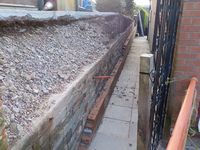
This photograph shows the collapsed wall from the owner’s side of the higher ground level. The wall owner had obtained an engineer’s report claiming that drains beneath the paving slabs had failed, causing rotation of the foundations. It was asserted that this, combined with the weight of retained ground, led to collapse.
Our Leicester surveyors’ investigation quickly demonstrated that this explanation was unlikely.
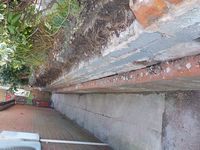
This view shows the wall from the opposite direction. Although not immediately obvious in photographs, the wall was found to lean consistently along its entire length.
This is significant. Drain failures typically result in localised movement, as pipes fracture or collapse at specific points. Resulting subsidence is usually confined to a limited area rather than causing uniform displacement across a full wall length.
Further inspection revealed that the wall was constructed with separate brick and block leaves, with no evidence of adequate wall ties. As a result, the two leaves were able to act independently rather than as a single structural unit.
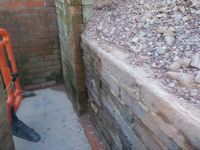
In this image, part of the wall remains upright because it is laterally restrained by an adjoining wall visible to the left. An expansion joint was present between the two sections.
The blockwork leaf sits behind the brickwork at the base but projects beyond it at the top, indicating poor construction alignment. The retained fill behind the wall consisted largely of gravel. While gravel is free-draining, retaining walls are most commonly forced over by wet clay, which becomes significantly heavier and expands when saturated.
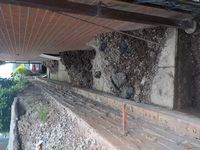
Three trial pits were excavated:
One at each end of the garage
One centrally along the wall
The foundations were found to be of good quality and depth, clearly visible in the excavation. The drainage pipe ran along the wall and was bedded in gravel throughout its length. This would allow any leaked water to disperse freely rather than accumulate beneath the foundations.
A separate drainage inspection confirmed that the drains were in very good condition, with no evidence of fracture, collapse, or leakage.

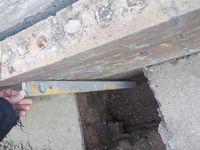
A vertical level placed against the wall above ground showed a widening gap towards the base, indicating outward rotation of the wall above ground level.
However, further measurement demonstrated that the wall was entirely plumb below ground level, confirming that foundation rotation due to drainage failure was highly unlikely.

Our RICS Chartered Surveyors concluded that the most likely cause of collapse was defective construction, not drainage failure.
The absence of adequate ties between the brick and block leaves allowed them to act independently. One leaf was pushed onto the other by retained fill, leading to progressive instability. The ground beneath the paving slabs provided restraint below ground level, keeping the wall vertical until failure occurred above.
This conclusion was fully supported by:
Trial pit evidence
Level survey measurements
Drainage inspection reports
CPR 35–compliant Expert Witness Reports
County Court and High Court instructions
Defective workmanship disputes
Boundary and neighbour disputes
Independent, unbiased expert opinion
A CPR 35 Expert Witness Report is an independent report prepared in accordance with Part 35 of the Civil Procedure Rules. Its purpose is to assist the court by providing unbiased professional opinion based on inspection, evidence, and expertise.
An Expert Witness Surveyor is typically required in disputes involving defective workmanship, boundary walls, structural failures, subsidence, drainage disputes, and other property-related matters where independent technical evidence is needed for court proceedings.
Yes. Our RICS Chartered Surveyors act independently and impartially, with a duty to the court rather than to the instructing party, in full compliance with CPR 35 and RICS Practice Notes.
Yes. Our reports are prepared specifically for use in County Court proceedings and comply with CPR 35 requirements, including statements of truth and expert declarations.
Where relevant, we carry out detailed inspections including trial pits, foundation exposure, and review of drainage surveys to determine the likely cause of failure or movement.
Yes. We accept instructions from solicitors, insurers, property owners, and adjoining owners, acting for either side while maintaining full independence.
Yes. We can act as a Single Joint Expert where instructed by both parties or appointed by the court.